The Round That Came Back: Understanding the Real Danger of Ricochets in the Field
It doesn't make the hunting magazines. It doesn't get discussed around the campfire. But ricochet incidents happen every season across the American West, in the canyon country of Utah, the rock-studded ridgelines of Wyoming, and the granite-floored basins of the Cascades. Most end without injury. Some don't. And almost all of them involve a shooter who understood ballistics reasonably well but never thought seriously about what happens when their bullet meets something it can't stop.
This isn't a lecture about firearm safety basics. It's a deeper look at the physics and practical realities of bullet deflection in hunting terrain — and why the hunters who understand it make fundamentally different decisions about shot angles, target backgrounds, and field positions.
What a Ricochet Actually Is
A ricochet occurs when a projectile strikes a surface at an angle shallow enough that instead of penetrating or fragmenting completely, it deflects and continues traveling in a new direction. The physics governing this are not random. They follow predictable — if complicated — rules based on bullet construction, impact velocity, surface hardness, and most critically, the angle of incidence.
The general rule is that angles of incidence below about fifteen degrees dramatically increase ricochet probability on hard surfaces. Flat rocks, still water, frozen ground, and hard-packed desert soil are all capable of deflecting a rifle bullet at remarkably low energy loss. A round that strikes hard granite at a grazing angle of five degrees may retain sixty percent or more of its original energy after deflection. That's not a harmless skip. That's a lethal projectile moving in an unpredictable direction.
Velocity matters, but not in the direction most people assume. Very high-velocity rounds don't always ricochet less — in some cases they ricochet more predictably because they deform less on initial contact and maintain their structural integrity through the deflection. Soft-point hunting bullets, designed to expand on impact with tissue, often fragment aggressively on hard surfaces, which distributes the hazard over a wider area rather than eliminating it. Bonded and monolithic bullets, prized for their deep penetration on game, are actually more prone to coherent ricochets because they hold together through deflections that would destroy a conventional cup-and-core projectile.
The Terrain Variables That Change Everything
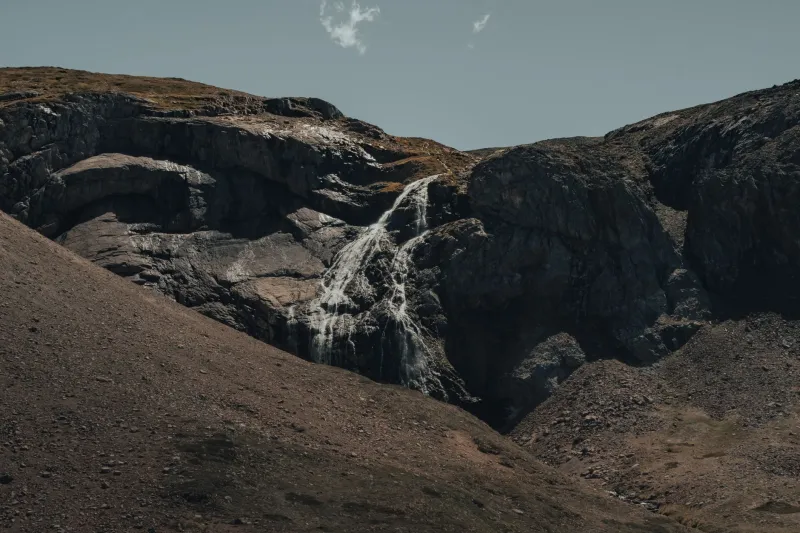
Hunters in the Rocky Mountain West and the canyon country of the Colorado Plateau work in environments that are essentially ricochet factories. Exposed sandstone, quartzite, and granite are everywhere. Talus slopes — those jumbled fields of angular rock below cliff faces that elk and mule deer love — present a particularly complex ricochet environment because a bullet striking one rock at a safe angle may deflect onto a second rock at a much shallower angle, producing a secondary ricochet that travels in a completely different direction than the original deflection.
Water is another factor that catches hunters off-guard. A round skipping across a still alpine lake or a flat river pool behaves similarly to one skipping off rock, and the deflected round can travel extraordinary distances. Historical military testing has documented rifle rounds deflecting off water at low angles and traveling well over a thousand yards after initial contact. Hunters shooting across or near water — particularly at low angles across flat terrain — need to account for this.
Frozen ground in late-season hunts presents a third variable. Dirt that was soft and bullet-absorbing in October can become essentially concrete by November in high country, and shots that would have terminated harmlessly in early season can ricochet violently on frozen terrain.
The Shooter's Side of the Equation
Most ricochet discussions focus on the bullet going forward and deflecting downrange. The more disturbing scenario — and the one that produces the most serious incidents — involves deflection back toward the shooter or adjacent members of a hunting party.
Backward ricochet is most commonly associated with hard, vertical surfaces struck at moderate angles — a cliff face, a large boulder, or a rock outcropping used as a shooting rest. When a bullet strikes a near-vertical hard surface at an angle that's steep enough to prevent a forward skip but not steep enough for clean penetration, the deflection can send fragments and sometimes the nearly intact projectile back along a path toward the shooter's position.
The distance involved in these incidents is often much shorter than hunters expect. Documented cases in law enforcement and military training environments — where steel targets and hard backstops are common — show that bullet fragments and deflected projectiles can return to the shooter's position from distances as short as twenty-five yards. In a hunting context, a shot taken from a rocky shooting position across a boulder field toward a target backed by a cliff face creates exactly the geometry for this type of event.
Practical Risk Mitigation That Actually Changes Behavior
Understanding the physics is only useful if it changes how you make decisions in the field. There are several practical habits that meaningfully reduce ricochet risk without compromising hunting effectiveness.
Target background assessment needs to extend beyond "what's behind the animal" to include "what's behind what's behind the animal." A deer standing in front of a grassy hillside looks safe. If that hillside is underlain by exposed rock ledges fifty yards further, a pass-through shot at the right angle can produce a secondary ricochet that travels laterally across the hillside.
Shot angle selection matters more in rocky terrain than most hunters realize. Slightly steeper downward angles — where terrain allows — drive bullets into the ground rather than along it. A shot taken from a slightly elevated position that drives the bullet into earth at a thirty-degree angle terminates far more predictably than a flat shot across a rocky bench.
Knowing your bullet construction is not just a performance question. It's a safety question. If you're hunting in terrain where deflection risk is elevated — rocky canyons, talus slopes, areas with exposed hardrock — understanding whether your chosen bullet will fragment aggressively or deflect coherently should be part of your ammunition selection process, not an afterthought.
The Uncomfortable Truth About Backup Shots
The most dangerous ricochet scenario in hunting isn't the carefully considered first shot. It's the rushed follow-up on a moving, wounded animal. Hunters chasing a hit deer across rocky terrain, shooting at odd angles under time pressure and stress, are operating in exactly the conditions that maximize deflection risk. The animal is moving. The terrain is complex. The shooter is elevated on adrenaline. And the deliberate target background assessment that governed the first shot is gone.
This is worth sitting with. The ethics and safety of follow-up shots in rocky terrain deserve the same deliberate thought as the initial shot — and in some cases, waiting for a better position is the right answer even when it means the animal moves further.
The wilderness doesn't offer controlled conditions. It offers physics. And physics doesn't care whether you were hunting responsibly or not when the round left the barrel.