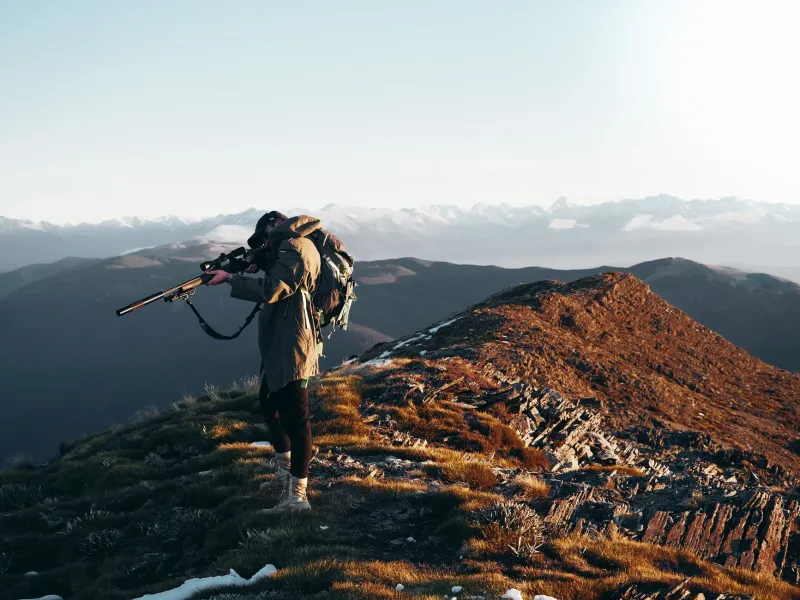
Hunt Like a Wolf: The Predator Instincts Elite Shooters Are Stealing from Nature
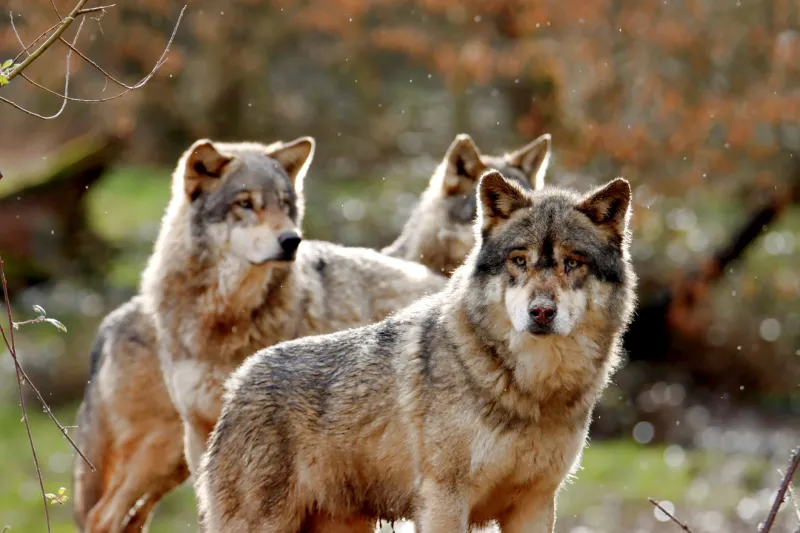
Spend enough time in the backcountry and you start to notice something humbling. The animals out there—the ones that kill to survive—are better at this than we are. Not better with equipment. Better in the fundamentals. Better at stillness, at reading distance, at managing the moment between decision and action. There's a reason wolves close a kill rate north of 80% on targeted prey while the average rifle hunter struggles to convert a chip-shot opportunity under pressure.
That gap isn't just physical. It's neurological, behavioral, and deeply instructive—if you're willing to pay attention.
The Stillness Problem
Watch a mountain lion work a deer from above. What's striking isn't the burst of speed at the end. It's the extraordinary patience before it. A cat will hold position for twenty, thirty, forty minutes, barely breathing, waiting for the exact geometry of the shot to present itself. There's no wasted movement, no premature commitment, no anxiety-driven early action.
Human hunters under pressure do the opposite. We move when we should hold. We rush when we should wait. The trigger breaks before the sight picture is clean because the brain—hijacked by adrenaline and the fear of losing the opportunity—overrides the shooter's better judgment.
Sports psychologist Dr. Elaine Trager, who works with competitive long-range shooters at several national-level matches, calls this "premature commitment syndrome." Her research suggests that most field shooting errors aren't mechanical—they're temporal. Shooters break the shot 0.3 to 0.8 seconds too early, in the window between a good-enough sight picture and a genuinely clean one.
The fix, she argues, isn't more trigger time. It's learning to tolerate the discomfort of waiting.
Eagle Eyes: What Raptors Teach Us About Visual Processing
A golden eagle hunting jackrabbits in the Great Basin can spot a target from over a mile away, track it through complex terrain at 150 mph, and make micro-corrections to its dive trajectory in real time. The biomechanics of that process have been studied extensively, and what researchers found is counterintuitive.
Eagles don't fixate on the target. They maintain what ornithologists call a "soft focus"—a broad spatial awareness that allows them to process movement across a wide field of view without locking onto any single point. The targeting happens late in the sequence, close to the moment of impact, not at the beginning of the approach.
This maps surprisingly well onto what top-tier competitive shooters describe as their process. PRS shooter Caleb Driscoll, who finished in the top 10 at the 2023 Precision Rifle Series finale, describes his pre-shot routine as deliberately wide-focus: "I'm reading the whole environment—mirage, wind indicators, my position, the target—before I narrow down. Shooters who lock onto the target too early lose situational awareness. They miss stuff that costs them the shot."
The eagle figured this out a long time ago.
Wolf Pack Discipline: The Art of the Committed Action
Wolves hunt in a way that human hunters rarely replicate: with complete, irreversible commitment at the moment of decision. Wildlife biologist Gordon Haber, who spent decades studying wolf behavior in Alaska, documented that wolves exhibit virtually no hesitation behavior between the decision to pursue and the actual pursuit. The deliberation happens before. Once the pack moves, it moves.
This is profoundly different from how most hunters operate under pressure. We second-guess mid-sequence. We adjust, re-adjust, and lose the moment in a fog of micro-decisions that should have already been made.
The training application is direct. Competitive shooter and hunting guide Trace Holman runs a drill he calls "commit and execute" with his clients at his Wyoming operation. The shooter identifies the target, makes all decisions about hold, wind call, and position in a deliberate pre-shot window—and then executes without revisiting those decisions. "The shot process is locked before the trigger hand engages," Holman explains. "Once you're in the execution phase, you're done thinking. The wolf doesn't stop to reconsider."
The Big Cat's Geometry Lesson
Leopards are ambush hunters with a near-perfect close-range kill rate—but they abandon stalks far more often than they complete them. Researchers tracking leopard behavior in South Africa found that a leopard will abort an approach if the geometry isn't right, even after investing significant time and energy in the stalk. They're optimizing for the shot that works, not for the shot that's available.
This is maybe the hardest lesson for hunters to internalize. The willingness to walk away from a marginal opportunity—the buck at a bad angle, the shot through questionable brush, the range that's at the outer edge of your confidence—is a predator skill. It requires ego suppression and a long-game mentality that doesn't come naturally under the pressure of a season's worth of anticipation.
But the hunters who build this discipline—who treat a passed shot as a success rather than a failure—are the ones who consistently put clean kills on the ground.
Building the Predator Framework
The practical training applications here aren't complicated, but they require intention.
First, practice stillness under pressure. Dry fire from field positions while holding for longer than feels comfortable before breaking the shot. Train the nervous system to tolerate the waiting.
Second, build a wide-to-narrow visual sequence into your pre-shot routine. Read the full environment before you settle into your optic. Don't let the target capture your attention before you've processed everything else.
Third, make your decisions early and commit completely. Wind call, holdover, position—all of it decided before you're in the trigger. The execution phase should be mechanical, not deliberative.
And fourth, practice walking away. Run scenarios in training where the right answer is to not take the shot. Build the discipline to recognize bad geometry before it becomes a bad outcome.
The wilderness has been running this curriculum for a long time. The smartest hunters are finally signing up for the class.