You Already Had the Shot — Here's How You Lost It in the Final Hundred Yards
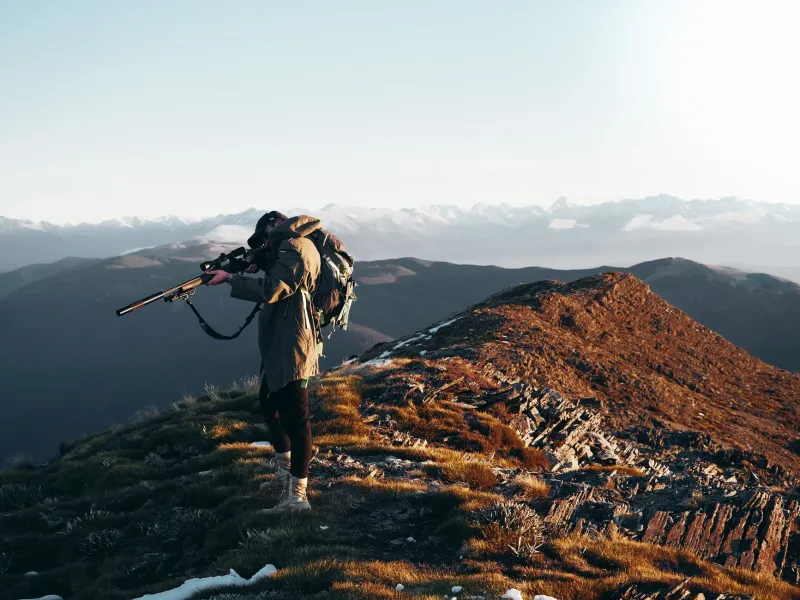
You've done everything right. The wind is in your face. The animal is feeding, calm, unaware. Your dope card is laminated and clipped to your stock. You've ranged the distance a dozen times in your head during the approach. Everything you've prepared for — the gear, the training, the ballistic obsession — has brought you to this exact moment.
Then a boot heel catches a loose rock. Or you swing your rifle barrel into a dry aspen branch. Or you stand up a half-second too fast and the elk's nose catches something it doesn't like.
Hunt over.
This is the part of hunting that doesn't get much airtime in the ballistics community. We love talking about long-range precision, terminal performance, and environmental variables. But the unglamorous, sweaty, nerve-wracking business of closing the final hundred yards? That's where more tagged animals are lost than at any other point in the process — and most hunters don't even realize it until they're walking back to camp empty-handed.
The Paradox of the Prepared Hunter
Here's the cruel irony: the hunters most likely to blow the final approach are often the ones who've invested the most in their long-range setup. When you've spent serious time and money on a precision rifle, quality optics, and a ballistic solver that accounts for everything from spin drift to Coriolis effect, your brain naturally gravitates toward the technical side of the shot. The approach starts to feel like the boring part — the thing you have to get through before the real work begins.
But experienced elk and mule deer hunters will tell you the opposite is true. The approach is the real work. Everything else is just preparation for it.
"I've watched guys who could shoot sub-MOA groups at 600 yards completely fall apart inside 80," says one veteran elk guide who's worked the high country of Colorado and Wyoming for over two decades. "They're thinking about the shot. They're not thinking about their feet."
That distinction — thinking about the shot instead of the approach — is at the root of most blown stalks.
Footing First, Always
The first thing experienced hunters learn to prioritize in the final hundred yards is foot placement. Not shooting position. Not wind. Footing.
In broken terrain — the kind of rocky, timber-edged country that elk and mule deer love — every step carries acoustic risk. Dry pine needles, loose shale, dead branches hidden under grass: the final approach is essentially a minefield of sound. And animals that have survived a season or two of hunting pressure have an almost supernatural sensitivity to anything that doesn't fit the natural soundscape.
The technique most seasoned hunters use is a slow, heel-to-toe roll — placing the heel softly, then rocking forward to feel the ground before committing full weight. It's slow. It's uncomfortable. And when your heart is hammering and your legs are burning from three miles of uphill approach, it takes a level of conscious discipline that most hunters simply haven't practiced.
"You have to make yourself slow down when every instinct is screaming at you to hurry," says a mule deer hunter from Nevada who's tagged big bucks in the kind of canyon country that punishes noise mercilessly. "The animal isn't going anywhere. But if you rush, it will."
The Scent Cone Problem Nobody Accounts For
Wind direction at the animal's location isn't the same as wind direction at your location — especially in canyon terrain, timber pockets, or anywhere thermals are doing complicated things. Most hunters check the wind at the start of the stalk and assume it holds. It rarely does.
In the final hundred yards, scent cone management becomes a dynamic problem, not a static one. Thermals that were pulling uphill in the morning can flip as temperatures change. A slight terrain feature — a rock face, a drainage, even a dense stand of timber — can redirect airflow in ways that funnel your scent directly toward an animal you thought you had dead to rights.
The fix is continuous monitoring. Experienced hunters carry some form of wind indicator — whether that's a dedicated powder puffer, a piece of sewing thread tied to their pack strap, or even a lighter held up to check flame direction — and they check it every twenty to thirty yards in the final approach. Not once at the trailhead. Every few steps.
When the wind shifts, you stop. You reassess. You don't push through hoping the animal won't catch it, because it will.
Weapon Handling in Close Terrain
Here's something that almost never comes up in ballistics discussions: rifle muzzle awareness during a stalk. In open country, it's a non-issue. But threading through timber, crawling over deadfall, or moving through thick brush with a scoped rifle introduces a whole set of mechanical noise risks that can end a hunt in an instant.
A scope objective bell catching a branch. A sling swivel clicking against a buckle. The bolt handle ticking against a rock as you belly-crawl into position. These sounds are small in isolation. In the stillness of the final approach, they're enormous.
The solution is deliberate weapon control — keeping the muzzle elevated and clear, managing the sling to prevent hardware contact, and being conscious of the rifle as a physical object moving through space. Some hunters go so far as to tape their sling hardware before a stalk. Others remove the sling entirely and carry the rifle in both hands, which also keeps it ready for a faster mount if needed.
Positional discipline matters here too. Getting into shooting position in the final approach should be practiced — not improvised. Hunters who've never drilled on transitioning from a low crawl to a stable shooting position under pressure often fumble it when it counts. The rifle comes up crooked. The scope is in the wrong spot. A shot opportunity that was there for eight seconds disappears before the crosshair settles.
Breathing and the Nervous System
The physiological reality of a close-range stalk is that your body is in a full stress response. Cortisol, adrenaline, elevated heart rate — all of it is working against the fine motor control you need for a clean shot. The longer and harder the approach, the worse this gets.
Breathing discipline in the final yards isn't just about shot execution. It's about keeping your nervous system calm enough to make good micro-decisions. Slow, deliberate nasal breathing during the stalk — even when you're physically taxed — keeps arousal levels lower and cognitive function sharper. It sounds simple. It's genuinely hard when you're watching a 350-class bull feed toward a shooting lane.
The hunters who tag out consistently in close-quarters country have usually internalized this at a level where it's automatic. They're not thinking "breathe slow." They're just doing it, the same way they're managing their feet without consciously thinking about each step.
The Real Last Mile
All the ballistic preparation in the world means nothing if you can't close the deal when the animal is close enough to hear you think. The final hundred yards of a stalk is where the hunt is actually won or lost — not at the bench, not on the ballistic solver, not at the trailhead.
Treat it like the skill it is. Practice moving quietly. Drill on shooting positions that emerge from a crawl. Check your wind obsessively. Slow your feet down when your brain wants to rush.
The shot is easy compared to this. The shot is just physics. The approach is everything else.