Your Nervous System Is the Trigger: How Adrenaline Makes or Breaks the Backcountry Shot
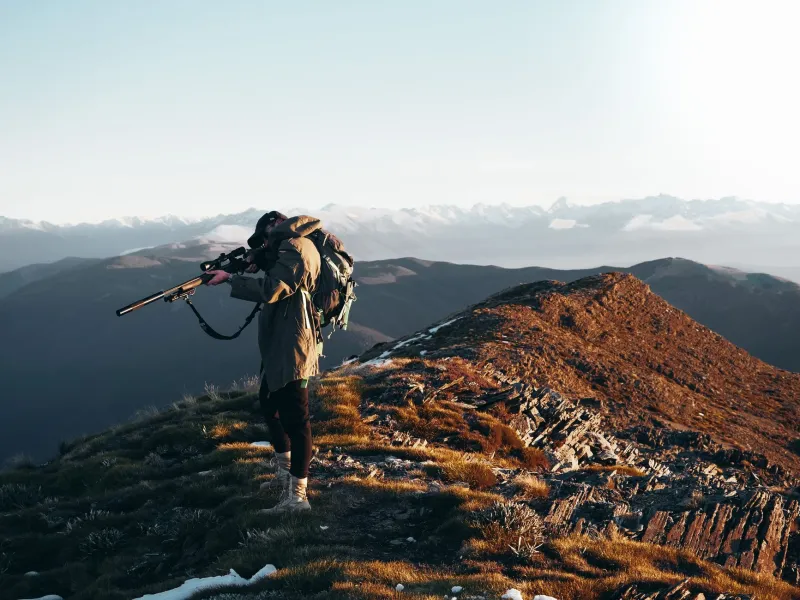
Every serious backcountry hunter knows the feeling. You've covered eight miles of nasty terrain, gained three thousand feet of elevation, and you've just crested a ridge to find a bull elk standing broadside at two-hundred yards. Your heart rate spikes from a steady hiking cadence to something that feels like a jackhammer. Your hands get a little electric. Your breathing goes shallow. And somewhere between the moment you see that animal and the moment you need to break the shot, your body starts working against you.
This isn't weakness. This is biology. And understanding the exact physiology of what happens in those critical seconds is the difference between a clean harvest and a wounded animal disappearing into the timber.
The Cascade That Changes Everything
The moment your brain registers a target — especially after a physically demanding stalk — it triggers a hormonal response that hasn't changed much since humans were hunting mammoths with sharpened sticks. The adrenal glands dump epinephrine (adrenaline) into the bloodstream almost instantly. Cortisol follows within seconds. Blood gets redirected from fine motor muscle groups toward the large muscles of the legs and core. Your pupils dilate. Peripheral vision narrows. Reaction time improves for gross motor movements while precision motor control takes a significant hit.
For a linebacker trying to shed a block, this is ideal. For a hunter trying to execute a precise trigger pull on a sub-MOA shot, this is a problem.
The phenomenon most hunters recognize as "buck fever" isn't an emotional weakness or a lack of experience. It's a physiological state in which your body has correctly identified a high-stakes situation and prepared itself for explosive physical action — not for the kind of fine-tuned stillness that a clean shot requires. Even elite shooters experience this cascade. The difference is they've learned to work with it rather than fight it.
What the Extreme Sports World Already Figured Out
High-performance athletes in extreme sports — big mountain skiers, free solo climbers, BASE jumpers — have been studied extensively for their ability to perform precise technical actions under acute stress. What researchers have consistently found is that top performers don't suppress their adrenergic response. They channel it.
In practical terms, this means learning to distinguish between two very different physiological states that often feel identical from the inside. The first is productive arousal: elevated heart rate, heightened sensory awareness, and a sharpened focus that actually improves your ability to read wind, judge distance, and track animal movement. This is the adrenaline you want.
The second state is counterproductive overarousal: the point at which hormone levels push past the zone of optimal performance and begin degrading fine motor control, distorting time perception, and creating the tunnel vision that makes hunters miss things happening just outside their crosshairs. The physical symptoms are similar, but the mental state is fundamentally different — reactive rather than controlled, scattered rather than focused.
The gap between these two states is narrower than most hunters realize, and it shifts based on physical exhaustion, altitude, caloric deficit, and sleep quality — all of which are standard variables in a serious backcountry hunt.
The Physiology of Tunnel Vision and Why It Gets People Killed
Tunnel vision under adrenaline stress is worth understanding in detail, because it doesn't just affect shot placement. It affects safety. When cortisol and epinephrine reach peak levels, the brain's threat-detection systems effectively commandeer attentional resources from the prefrontal cortex — the part of your brain responsible for deliberate, rational decision-making. Your field of view literally narrows. Background and context disappear. The target becomes everything.
For hunters, this means that in a high-stress shot situation, you may genuinely fail to register what's behind your target, what's moving in your peripheral vision, or whether the animal has shifted its position since you last checked. This is not carelessness. It is a documented neurological phenomenon. Understanding that it will happen is the first step toward building habits that compensate for it.
Pre-shot checklists — the kind competitive long-range shooters use almost ritualistically — aren't just about mechanics. They're about forcing the prefrontal cortex back online during moments when the brain's stress-response systems are trying to take over. Running a mental checklist creates a deliberate cognitive interrupt that pulls attention away from the adrenaline-driven fixation on the target and redistributes it to the broader shooting solution.
Practical Tools That Actually Work in the Field
The breathing protocols used by military snipers, competitive shooters, and high-stakes surgeons all share a common mechanism: they activate the parasympathetic nervous system — the body's counterbalance to the fight-or-flight response. Tactical breathing, sometimes called box breathing, involves a four-count inhale, four-count hold, four-count exhale, and four-count hold before the next breath. Even one or two cycles of this pattern measurably reduces heart rate and cortisol levels within seconds.
For hunters, the application is simple but requires practice before the season, not during it. The pattern needs to be automatic enough that you can execute it while keeping your eye on the animal. That kind of ingrained response only comes from deliberate training under conditions that actually elevate your heart rate — not from reading about it.
Dry-fire practice after a set of burpees or a hard sprint simulates the physiological state you'll be in after a stalk far better than calm, deliberate range sessions. It's not comfortable, and it doesn't look impressive at the range. But it trains the nervous system to execute a precise trigger pull when the body is flooded with stress hormones, which is exactly the situation you'll face in the field.
The Gut Check Most Hunters Skip
There's a harder conversation embedded in all of this, and it's one that doesn't get enough airtime in hunting culture. Not every adrenaline state is recoverable in the field. There are moments — especially after a brutal physical approach at altitude, on low sleep, with low blood sugar — when the honest answer is that your body is not in a state to take a responsible shot at a specific distance or target presentation.
Elite competitors in precision shooting sports talk about this openly. Knowing when not to shoot is a skill. It requires the same self-awareness and physiological understanding that makes clean shots possible in the first place. The animal that walks away because you recognized you weren't in a controlled state is a far better outcome than the one that disappears into dark timber with a poorly placed round.
Your rifle is only as good as the body holding it. And that body runs on biology, not willpower.