The Same Wind That Burned Your Stalk Is Ruining Your Shot

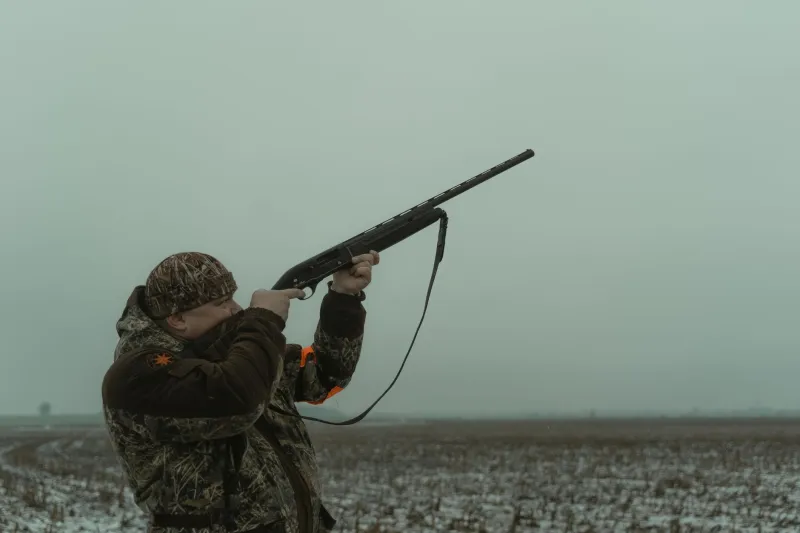
Photo by Photo by Alex Moliski on Unsplash on Unsplash
There's a hunter somewhere on a western ridge right now doing two completely separate things. He's checking wind direction with a puff bottle before his stalk, reading thermals carefully to stay off a bull's nose. Then he gets into position, settles behind his rifle, punches a number into his ballistic app, and dials for wind based on the reading from a Kestrel sitting next to his pack.
He's treating the wind like two different problems. It isn't. It's one problem — and the animals in front of him already understand it better than he does.
Wind Is Not a Number, It's a System
Most hunters think about wind in one dimension: speed and direction at their position. Ballistic apps ask for it, Kestrels measure it, and range cards account for it. That's a useful starting point. It is not, however, what your bullet actually flies through.
The air between your muzzle and your target is a column of moving gas that changes direction and velocity at multiple altitudes simultaneously. In mountain terrain especially, this column is stratified — thermals push warm air upward along sun-heated slopes in the morning, while cooler air drains down draws and drainages in the evening. A crosswind at your shooting position might be running at 8 mph from the west. Fifty feet off the ground and two hundred yards downrange, it could be doing something completely different.
This is micrometeorology, and it governs everything that matters in the backcountry: where your scent goes, how far sound travels, and where your bullet lands.
Reading Animals as Wind Instruments
Here's the part that experienced backcountry hunters know but rarely articulate: prey animals are the best wind-reading instruments in the field. They have to be. Their survival depends on understanding air movement at a granular level that no handheld device can replicate.
Watch a mature mule deer buck working across a hillside. He's not just moving — he's constantly sampling the air, orienting his nose to check multiple directions, pausing at terrain features that concentrate or redirect scent. When he stops and tests the wind on the downwind side of a ridgeline, he's telling you there's a thermal eddy there. When a cow elk suddenly throws her head up and stares at a seemingly empty slope, something in the air current shifted and brought her a signal she didn't expect.
These behavioral cues map the invisible. And that map is exactly what a long-range shooter needs, because the same eddy that's carrying scent to that elk's nose is running perpendicular to what your Kestrel is showing you.
How Scent Drift and Bullet Drift Run the Same Lines
Scent molecules and bullets both obey the same atmospheric physics. Wind carries both downrange, deflects both laterally, and creates the same turbulence around both when air flows over terrain features like ridges, boulder fields, and timber edges.
If you've spent any serious time in the backcountry, you've experienced the maddening reality of thermals reversing mid-stalk. You checked the wind, it was perfect, you moved 200 yards closer — and suddenly a deer blew at you from a direction that made no sense. What happened is that the terrain channeled a secondary air current you didn't account for. That same secondary current, had you taken a shot at that moment, would have pushed your bullet 6 to 10 inches off course at 400 yards.
The connection isn't metaphorical. It's literal fluid dynamics. Hunters who understand this stop treating wind as a ballistic variable and start treating it as an environmental system they need to read holistically.
Sound as a Mapping Tool
Sound behavior in mountain terrain adds another dimension to this framework. Sound travels on air — it bends around terrain features, gets carried downwind, and attenuates or amplifies depending on atmospheric layering. This is why you can sometimes hear a bull bugling clearly from two miles away on a cold, still morning, and struggle to hear him at half that distance when thermals are churning.
For hunters, the practical application is this: if you can hear an animal clearly, you have a decent read on the primary air mass between you. If sound is behaving strangely — seems to come from the wrong direction, cuts in and out, or carries with unusual clarity — the atmosphere is doing something complex. That complexity is almost certainly affecting your bullet's flight path as well.
Pay attention to how sound travels before you shoot. If a distant shot from another hunter sounds wrong — too loud, too soft, coming from the wrong vector — the air is stratified. Recalibrate your wind assumptions.
Building a Unified Field Picture
The framework that ties this together isn't complicated, but it requires discipline to execute consistently.
Before the stalk, map the air. Use puff bottles, watch grass and tree movement at multiple elevations, note where thermals are running. This isn't just scent management — you're building a picture of the atmospheric column your bullet will travel through.
Watch the animals. Where are they orienting their noses? What behavior suggests they're catching scent or sound from unexpected directions? This real-time animal behavior is wind data you can't get from any instrument.
Identify terrain features that create wind shadows and eddies. Ridgelines, rock formations, and timber edges all redirect airflow. If your shot crosses one of these features, assume the wind on the far side is different from what you're measuring at your position.
Apply a conservative wind correction. When atmospheric conditions are complex — changing thermals, variable readings, animal behavior suggesting multiple air currents — widen your wind correction margin. If your app says 4 inches of drift, shoot for 5 or 6. The atmosphere rarely behaves as cleanly as your inputs assume.
Don't take the shot if you can't read the air. This is the hardest discipline in long-range hunting, but it's the right call. A complex, unreadable wind environment at 500 yards is not a problem a ballistic calculator can solve for you. Closing distance is almost always the better answer.
One System, Not Three
The hunters who consistently punch tags in hard country have internalized something that takes most people years to learn: the wind is not three separate problems for your nose, your ears, and your rifle. It's one environment, moving as a single system, affecting everything simultaneously.
When you stop managing scent, sound, and ballistics as separate disciplines and start reading them as expressions of the same atmospheric reality, your success rate climbs — not because you got better gear, but because you finally started seeing the whole picture.