Stop Plinking, Start Training: Combat Marksmanship Lessons Every Deer Hunter Should Steal
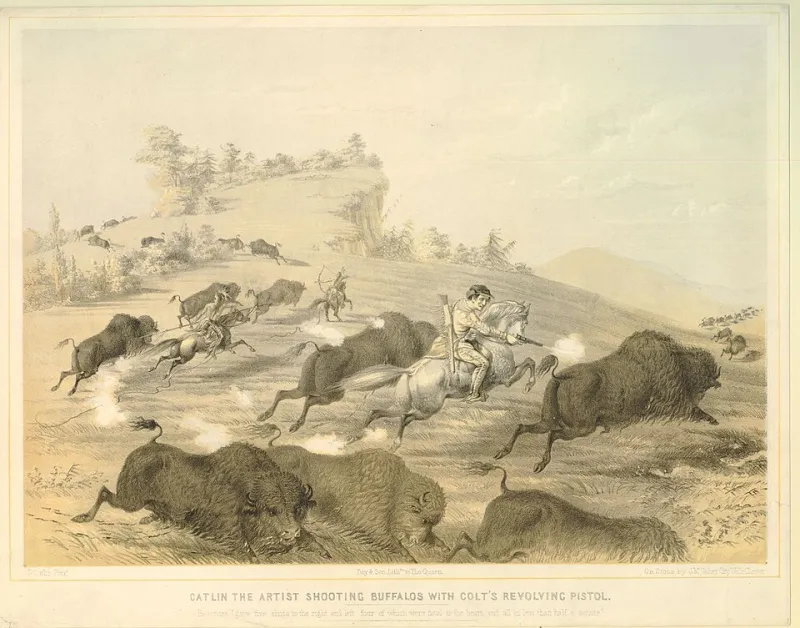
Photo: Print made by: J Mccahey Chester After: George Catlin Printed by: Day & Co Published by: Day & Co (?), Public domain, via Wikimedia Commons
Here's an uncomfortable question: when was the last time you took a shot at a deer from a perfect seated bench with unlimited time, no wind, and a target that held still while you checked your zero?
Never? Then why is that how you practice?
The average hunter's range routine looks like this: drive to the bench, sandbag the rifle, fire three-shot groups at 100 yards, admire them, leave. It's comfortable. It's also almost completely useless for preparing you for the actual moment — cold hands, pounding pulse, an animal that might step behind a sapling at any second, and a window of opportunity measured in heartbeats.
The military spent the last century figuring out how to train people to shoot under exactly those conditions. Most of that doctrine translates directly to a November treestand or a frozen fence line. Here's what's worth stealing.
Principle One: Positional Shooting Beats Bench Rest
In combat marksmanship, the bench doesn't exist. Soldiers train from prone, kneeling, sitting, and standing, because that's what reality offers. Hunters should do the same.
Your deer will almost never present itself while you're comfortably seated at a bench. It'll present itself while you're kneeling on a hillside, leaning against a tree, or — worst of all — standing with nothing but your own skeleton for support.
The drill: Every range session, shoot your rifle from prone, kneeling, sitting, and standing at 100 yards. Don't worry about the groups at first. Worry about learning your wobble zone — how much the sights move in each position — and learning when a shot is actually there versus when you're hoping.
Once you know your standing wobble is a six-inch circle at 100 yards, you've learned something that'll stop you from taking a low-percentage shot on a buck. That knowledge kills more wounded deer than it creates.
Principle Two: Stress Inoculation Is Trainable
The military discovered long ago that heart rate destroys fine motor skills. Above roughly 150 beats per minute, your vision narrows, your hands shake, and the complex trigger control you built on the bench starts falling apart. You can't eliminate buck fever. You can inoculate against it.
The drill: Before every shot string, do enough physical work to spike your heart rate — burpees, a sprint up the range hill, a heavy pack carry. Then get into position and make the shot. Breathe, settle, break the trigger.
The first few times, your groups will embarrass you. Within a few sessions, you'll learn to shoot well with your pulse hammering — and that skill transfers more directly to a live animal than a thousand bench rounds ever will.
Principle Three: Shot Triage — When Not to Shoot
Combat shooters are taught target discrimination: not every presented target is a target you engage. Hunters need the same discipline, and it's the piece most training ignores.
The drill: Set up multiple paper targets at varying angles, some clear, some partially blocked by brush or a prop. Have a buddy call "stand" or use a timer. Your job: decide in three seconds whether the shot is there, and if it is, take it. If it's not, hold.
Track your decisions, not just your hits. Passing a marginal shot is a skill, and like any skill, it degrades without practice. The hunter who has rehearsed saying "no" at the range is far more likely to say it when a buck quarters away behind a fence line.
The Training Plan
Here's a simple session that replaces bench plinking entirely. Run it twice a month from summer through season:
- Zero check from prone — 5 rounds, confirm the rifle (bench time is over after this)
- Positional ladder — 4 rounds each from kneeling, sitting, and standing at 100 yards
- Stress string — sprint or burpees, then 3 rounds from a field position, no sandbags
- Triage drill — timer, mixed targets, 5 rounds with shoot/no-shoot decisions
- Cold bore finisher — one shot, first thing next session, record it every time
That's roughly 25 rounds a session. It's less ammo than most guys burn in an hour of plinking, and it's worth ten times more.
The Real Target
The military doesn't train soldiers to shoot paper. It trains them to perform when everything is wrong. Hunters face a milder version of the same problem — cold, adrenaline, awkward positions, a living target — and most of us train for none of it.
The bench is where you confirm a rifle works. The field positions, the stress, the decisions — that's where you confirm the hunter does. Train the second thing and the first takes care of itself.